sewing projects

all posts related to sewing projects, patterns I’ve used, and sewing related goals or tips

Operation: Save the Petticoat! (Or, A Simple Petticoat Alteration)

Operation Save the Petticoat (Or a Simple Petticoat Alteration), the artyologist

Less than a week before Easter, I realized that the dress I was planning to wear on Easter Sunday required a petticoat, and that I did not have a petticoat which I could wear under it.

I have one longer length 29″ starched crinoline which I got at a thrift store a few years ago, and it works perfectly for the few 1950’s tea length gowns I have. Because of the longer length, this crinoline doesn’t work for my “regular” length skirts and dresses though, which are usually somewhere around 24″-25″ long, so a few years ago, I also invested in a Doris Petticoat. I decided to buy a Doris Petticoat because I had seen several other bloggers wearing them, and they are so, so pretty since they are made of over 36 metres of fluffy and soft nylon lingerie netting and ruffles. There could be nothing more perfect in my mind than a peach coloured ruffled petticoat, so I decided to buy the 21″ length one, and then waited expectantly for it to arrive. Imagine my disappointment when it arrived and I discovered, when I tried it on, that it was simply too full for the majority of my dresses! I did have one circle skirted dress it fit under, so I wore it with the petticoat a few times. I realized though, that while I do love the extremely full and dramatic silhouette of the 1950’s, for some reason, I felt very self conscious when wearing an extremely pouffy skirt for daywear. When I see pictures of other vintage ladies, I never think that their skirts are too full- but as soon as I am wearing one, I feel a bit unsettled. Give me a ridiculous hat and I will walk tall and proud- but an extremely wide petticoat makes me nervous! (Oh, and so sorry that my massive skirt with a mind of it’s own just bumped into your priceless vase. . . )

So, with great reluctance, I stuffed the petticoat back into it’s bag and hid it in the back of my closet so I wouldn’t feel bad every time I looked at it. It came out of hiding a few times for costumes etc. but not as a regular part of my wardrobe.

Well, back in October I was reading Lily’s blog, Mode-De-Lis, and she shared a post about different styles of petticoats and what kind of shape they give and how she liked them. She had altered her Hell Bunny petticoat with a cotton yoke, so that it would be more comfortable, and suddenly I realized that I should alter my petticoat! Fast forward to the week before Easter, and I realized that it was time to enact Operation: Save the Petticoat.

I was a bit nervous cutting apart my petticoat: after all what if I ruined it?! But then I realized that it wasn’t doing any good unloved and unworn in the back of my closet, so I decided to go ahead with the petticoat alteration. Here is how I altered it and ended up turning it into two separate petticoats of different lengths, which can also be worn together, if needed someday in the future.

The first step in the petticoat alteration, was in creating a yoke. I decided to create a yoke because, like Lily, I found the elastic waist to be rather bulky, as well as shifty. I was always afraid that it was going to slide down and poke out the bottom of my skirt. Creating a yoke, solved this problem by making the top fit smoothly and securely, while also reducing bulk. (Because who wants bulk right at their waist?)

Operation Save the Petticoat- materials, the artyologist

I made the top out of a few scraps of cotton in our scrap bin (exactly enough to make this yoke- so keep those scraps- you never know when you might need them!) In order to create the shape, I took a basic skirt pattern, traced it and then figured out where I wanted the yoke to end, which was 8 inches down. I then cut out the fabric at this length.

I decided to French seam the side seam, as I wanted this to be perfectly finished inside and out. For the other side (the opening) I pressed the seam allowance in, to cover all the raw edges, and then sewed up from the bottom about an inch. At this stage, I tried it on to see if I could pull it up over my hips, and over my head (before I got it all sewn together and discovered that it was too short or something).

Simple Petticoat Alteration, the artyologist, how to yoke

Once I had made sure that the yoke fit well, I turned under the seams and topstitched to finish neatly. To finish the top edge, I had thought about creating a facing, but then decided to cover the raw edge with bias tape instead. Bias tape was my mom’s idea and was a lot quicker than creating a facing, and it made a nice edge without too much bulk. Once that was done, it was time to add the petticoat ruffles.

I took apart the elastic waistband/casing of the petticoat, which left me with a tube of tricot with ruffles sewn on either end. I then measured up from the hem to the length that was required. Since the yoke was 8″ and the finished length I wanted was 24″, I measured up 16″ and added 1/2 inch for a seam allowance. I pinned all the way around, (since I currently don’t have a fabric marker) and then cut neatly all the way around.

Simple Petticoat Alteration, the artyologist, petticoat ruffles

Once the piece was cut, I was left with a very short and wide petticoat 🙂 Now it was time to sew the petticoat to the yoke. As the petticoat was wider than the yoke, I just eased it in as I sewed without worrying too much about it if I got some pleats in the fabric. Once I had sewed the petticoat on, I serged the edge of the seam to give it a nice finished edge.

With that, the petticoat was done, except for buttons. I decided to do small buttons and button loops, so I marked where my buttons needed to be, and then created thread loops using this method below. With that, the first petticoat alteration was done!

Simple Petticoat Alteration, the artyologist, button loop instructions

Simple Petticoat Alteration, the artyologist, button-details

After I had made this first petticoat, I decided I might as well take the remaining half and create a shorter one. I don’t like my petticoats sticking out below the skirt, so I thought that creating a 21″ petticoat would be perfect for those few dresses I have which fall at exactly knee length. For this one, I decided to simply sew some wide lingerie elastic around the top and call it done. But, of course that would have been too easy, right? When I tried this shorter petticoat with my dresses, I realized that the fullness had too much of a rockabilly flair and I am simply not a rockabilly girl. The petticoat was too full for it’s length, and so I realized that (horror of horrors!) I needed to reduce the fullness. So, now began Operation: Dismantle the Petticoat.

When Doris Petticoats tells you that their petticoats are made up of more than 36 metres of fabric, they are not kidding. The first step in this petticoat alteration was in taking the bottom tier off of the petticoat, which resulted in more than 17 metres of ruffles!

Simple Petticoat Alteration, the artyologist, ruffles and second petticoat

I decided to reduce the fullness of the petticoat by about a 1/3 as I figured that would be enough, and I wasn’t sure whether reducing it by 1/2 would be too much. I cut the bottom tier at 12 metres and then came to the odious task of regathering the nylon back onto the top tier (while also distributing the fullness evenly all the way around; so I wouldn’t end up with an unevenly shaped petticoat that was fuller on one side!) This probably took the better part of 2 hours to do. Once it was all regathered, I pinned it within an inch of it’s life- and then went to bed! 🙂

In the morning, when I was ready to tackle the job again, I took the petticoat and ran it through the serger. This took care of the edge seams, as well as sewing both pieces together all in one step. I did end up with some areas that missed the stitching, since it was a massive amount of fabric to work with- so I ran it through twice.

Once the tiers were all gathered back together, I was almost done. All that was left was to sew the skirt back onto the elastic waistband. I sewed it near the top, to get the proper length, and was initially planning to sew two rows- one at the top and one at the bottom of the elastic for stability. However, when I tried it on, the elastic accidentally flipped inside out and I realized that if I left it with one row of stitching I could flip it in or out depending on which length of skirt I was wearing. It is now essentially a convertible petticoat! Yay!

Simple Petticoat Alteration, the artyologist, altered tops

So, after all that, I ended up wearing the convertible petticoat for Easter Sunday, as it turned out to be the perfect length to wear with my Easter dress which is a bit on the shorter side.

I was at first nervous to cut it apart and attempt a petticoat alteration, but I am so glad I did! After two years of owning it, I now have a petticoat that I can actually wear. I have worn it a couple of times now with my knee length skirts, and it adds such a nice fullness, shape and swish to my skirts. It was amazing how simply reducing the amount of ruffles in half made such a difference. I think now, that my petticoats are going to get a lot more wear from now on!

Have you ever altered something you purchased that didn’t work out for you the way you had hoped? Would you ever make or alter a petticoat?

You can see what a difference the petticoat gives to the shape of this dress. The perfect amount of “pouf”!

Simple Petticoat Alteration, the artyologist, before and after with petticoat

The Green Caped Crusader, In Butterick 3642

The Green Caped Crusader, Butterick 3642, the artyologist

Capes are amazing, don’t you agree? Superheroes wear them. Medieval warriors wear them. Little Red Riding Hood wears one. Movie starlets wear them. In short- you should wear one too. (Except if you are talking to Edna Mode in which case she will advise you “No capes!”) I had a black cape once, a few years ago, but unfortunately it hit me right at the widest part of my hip and I discovered that was a rather unflattering length. So after many years of admiring capes, I decided that it was high time I finally made a cape for myself. After all, how hard could it be to make a cape?

Well, considering that it is now March 17, and this is the first project I have completed this year… apparently it was a little more work than I first thought it would be. . .

The Green Caped Crusader, Butterick 3642, the artyologist, portrait

The first step to making my cape was choosing the fabric. My first thought was a length of plaid wool I picked up a few years ago. However, the mistake I made when I bought it was that I only purchased 1.5 metres, which is not enough to do much of anything with. I thought that I might be able to squeeze a cape out of it, but, alas, a cape takes a surprisingly large amount of yardage, and it was not to be. I was on the lookout for a nice wool, but the fabric stores didn’t have anything I wanted. Then, in January, when I was at the local thrift store, my sister noticed a length of green wool for sale for $10.00, for 2.8 metres. Thrift score!

I decided to line the cape in a gold/tan, because there was no green lining available. The other choices they had at the fabric store were brown or black, but I like how the gold picks up the warm tones of the wool. If you look closely at the wool, you will see that it is woven with gold, green, brown, cinnamon and russet coloured threads. If you can’t match your lining, it’s fun to contrast it so it becomes a feature.

The Green Caped Crusader, Butterick 3642, the artyologist, cape lining Butterick 3642

Now that I had the fabric picked out, the next step was the pattern. For a pattern I chose Butterick 3642. This was for no special reason, other than that I was at my local fabric store and this was the only cape pattern they had. I could have bought an indie pattern, but I never really thought about it, and this one seemed fine. I think that this pattern is actually out of print, and there was just one lone pattern left at my local shop! I was planning for a WWII nurses cape style, and the drawing on the back of this pattern looked quite similar in style to that. I decided that I wanted to make the cape knee length, which would put it at the hem length of most of my dresses and skirts. The pattern had two choices- mid calf and mid thigh- but it was simple enough to adjust the pattern to the length that I wanted it to be at.

At this point, I was a bad blogger and dove right into the project without taking any pictures! All, I got was a picture of the stack of fabric before I started cutting it. Oops. The cape went together fairly well, although it took forever to cut out the pieces as there was just enough fabric to fit all the pieces on, and it was like a puzzle to lay them all out exactly! It took me about two days to sew together the pieces, the lining, the collar and the buttonholes. . . and at this point you might wonder why I am writing this in March, not January.

The Green Caped Crusader, Butterick 3642, the artyologist, collar detail

Well, once I got the cape pretty much together, I realized that whoever designed this pattern must have planned to dress football players. The shoulders in the cape were much too wide and the shoulder point hung way off the edge of my shoulder. This resulted both in throwing the direction of the fabric off, as well as looking way too big. I was swimming in fabric. I didn’t know there was such a thing as a cape being too large- but this one was. At this point I was in the depths of despair at the thought of all the work I had done so far, and now had to undo, so I threw it away in disgust and didn’t pick the project up again for a month. (In defence, I was also busy during February preparing for my art show, so I didn’t have a lot of free time to devote to working on a fussy project that was turning out to be more complicated than I originally thought.) So, the abandoned project sat there until last week. I knew that if I didn’t do it now- it would never be done- and I really wanted to wear it! When contemplating what to wear for St. Patrick’s Day, I remembered that I own very little green, and knew that this cape would be the perfect thing. There’s nothing like a deadline to force you to hurry up and sew 🙂 (ps. I do have a small bit of Irish heritage, but have never done anything more to celebrate St. Patrick’s Day than dressing in green!)

The Green Caped Crusader, Butterick 3642, the artyologist, cape neck detail

In regards to fixing this pattern, I ended up pinching out about three inches of fabric from the shoulder and tapering it to the hem. Taking out that fabric made all the difference to the shape and fit of the cape. Instead of looking like I was wearing a blanket, it now falls somewhere between the fit and flare of a nurses cape, and a 40’s swing coat style.

The two things I do not like about how the cape turned out are, one, that the collar likes to roll out. I did everything, including cutting the under collar smaller, and steaming it in shape, but it does still like to flip out. However, if I decide that it bothers me too much, I can always wear it with a fur collar over top. The other thing, is that the hem puckers a bit. I’m planning on taking it in to my local dry cleaners for a pressing. I have gotten garments pressed before (without getting them dry cleaned), as it is actually quite cheap and gives a much more professional finish to a project that you just can’t achieve with an iron. I think getting home sewn garments professionally pressed is totally worth it- especially where wool is concerned.

The Green Caped Crusader, Butterick 3642, the artyologist, cape details

So there you have it. After all the trials that the fitting gave me, I wasn’t sure I was going to like the finished cape. I do have a history of getting my projects finished and then not liking them, but I actually love how this one turned out this time! I think I will be able to get a lot of wear out of this piece. This colour of green goes very well with so many colours, and capes are great for those chilly days where you need some form of outerwear, but not a buffalo robe. In other words, because I live in Canada, I am going to get a lot of wear out of this before Spring and Summer come around 😉

Would I sew Butterick 3642 again? I don’t think I would. The pattern doesn’t actually call for a lining, and adding a lining to a pattern is always tedious. The aforementioned fit problems were kind of bothersome too, so even though I have fixed them now, I don’t know if I would want to sew it again. I would also like to try a different style of cape, with a different kind of un-seamed shoulder. Maybe I’ll try an indie pattern next time!

Do you have a cape, or wish you had one? Do you have any recommendations for a different cape pattern than Butterick 3642? And, do you observe St. Patrick’s Day, and are you wearing green today?

Outfit Details:

Cape: Butterick 3642, now out of print

Hat: gifted

Shoes: Hispanitas

Dress: Thrifted

Brooch: Gifted

The Green Caped Crusader, Butterick 3642, the artyologist, green cape

The Green Caped Crusader, Butterick 3642, the artyologist, twirling

It passes the test: it’s perfect for twirling in!

The Green Caped Crusader, Butterick 3642, the artyologist, twirling, vent detail

The Green Caped Crusader, Butterick 3642, the artyologist, brooch detail and cape

The Green Caped Crusader, Butterick 3642, the artyologist, shoes

The Green Caped Crusader, Butterick 3642, the artyologist

The Reveal: Refashioners 2016 & Gertie’s Butterick 5882

The Big Reveal: Refashioners 2016 and Gertie's Butterick 8882, the artyologist

Hooray! I didn’t wait until the last possible moment to finish up my entry for The Refashioner’s 2016. This is a record, I think. I was fully expecting myself to leave it to the last week, (day? hour?) but I actually finished this project up last Wednesday- with a full week and a half to spare! (Let’s just overlook the fact that it took me 8 weeks to get the project done, even though it actually only took three afternoons of sewing to construct it. . . hehe.)

When I first heard about the Refashioners 2016 challenge at the beginning of August, I was intrigued, but also a bit apprehensive. I am not a denim girl. I used to wear blue jeans all the time, but in the last few years, they haven’t found much of a place in my wardrobe. Not that I hate denim, I just don’t seem drawn to it as much as I used to be. I did at one point have a pair of skinnies that I liked to pair with my fur coat as it made me feel rather hip 😉 but they have worn out now, and the only other pair are designated for painting and other messy home renovation projects (designated as such, because they are covered in paint). So, even though I loved the idea of taking part in the challenge- I had to think seriously about what I could make that I would actually want to wear after I made it- and I came up with the answer: a retro styled bustier/playsuit top. (And just in time to put it away for winter too! What ridiculous timing. . . )

The Big Reveal: The Refashioners 2016 and Gertie's Butterick, second view, the artyologist

So, in case you are here only to see the details, here they are first, and then I will continue after this to ramble on about how I made it, what mistakes I made (what? mistakes!?), and whether I will make it again. Oh, and show you a billion more photos too.

The Low Down:

  • Butterick Patterns by Gertie 5882 bodice pattern
  • Dark denim bodice made out of the bottom cutoffs of my sister’s old jeans
  • Light denim pleated inset made out of the back piece of the pant legs of my brother’s ripped jeans
  • Floral lining made out of a remnant from a past project
  • Boning leftover from a past project
  • A recycled vintage zipper from the stash
  • Thread we already owned
  • Cost= $0.00, since everything was from the stash!

The Big Reveal: The Refashioners 2016 and Gertie's Butterick, details, the artyologist

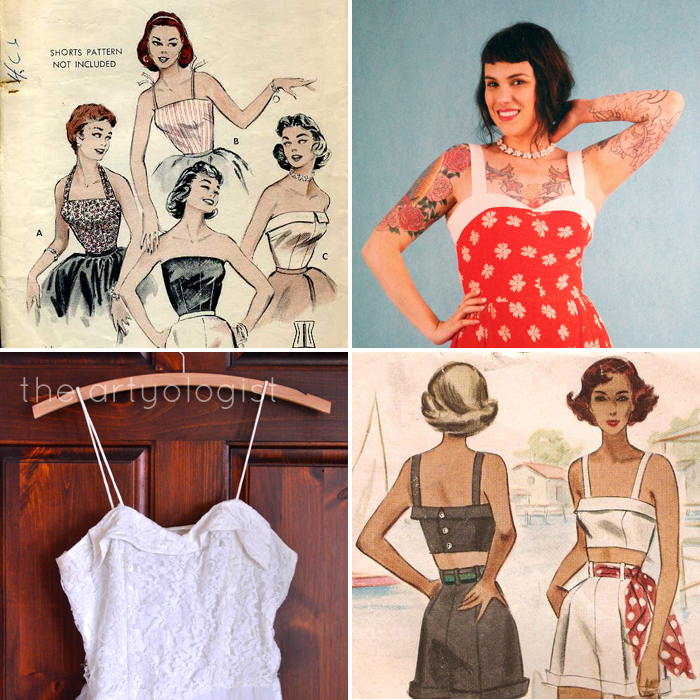
My inspiration, and details that I wanted to include in the final project:

  • A winged “collar” or any other bust detail for interest
  • 1″ crisscrossed or straight straps. No halter straps as I find they give me headaches 🙁
  • Ideally, I wanted to make the top out of patterned or coloured denim, or utilize two different washes of blue denim for contrast and interest
  • I thought about using topstitching or preserving some of the flatfelled seams, but it ended up coming across as “biker chick” rather than “vintage girl”
  • I was nervous about sewing with a stretch denim, but decided to do it so the top would be more comfortable for hot summer days (note that this pattern is designed for woven, but I was able to sew the stretch just fine. I also cut my lining on the bias, so that it would have some stretch too.)
  • I wanted to try out an exposed zipper, since I was planning on a centre back zipper anyways. Now that the exposed zipper trend is now. . .  you know. . . going out of style and all that. I’ve never been one for following the trends anyways 😉
  • In the spirit of the challenge, I wanted it to be made out of all recycled or remnant materials

inspiration for playsuit top the artyologist

photo source: 1, 2, 3 (my Grandma’s wedding dress) & 4

I have seen several fitted bodice tops like this before, such as this one from Deadly Dames, and I really like them, as they are an easy summer option to pair perfectly with 1950’s style skirts. My original plan was to take a tried-and-true dress pattern that I have, bone it, and then add a collar flip to the top neckline. This was a popular style of bodice in the 1950’s, as I have seen several patterns utilize a detail like that, and even my Grandma’s wedding dress from the 1950’s has a collar flip like that. The Sweetheart Sundress pattern from Gertie’s New Book for Better Sewing uses this detail as well. I’ve always liked this style, and this seemed like the perfect opportunity to try it out. Well, as you can see from the finished garment, I obviously didn’t end up sticking with that plan, and here’s why.

first-try_edited-1

Left: the failed first try. Right: so many different colours in one pair of jeans!

I started with an old faded pair of stretch jeans from my sister, (just to test things out first) cut out the pattern, sewed it up, tried it on, and then decided that it just didn’t have enough structure (as I was planning to wear this without any other underpinnings). It just felt like the bodice was the wrong shape, even with the addition of boning, and I thought that I would always feel slightly uncomfortable wearing it. I also wasn’t happy with the shape of the top neckline. After fiddling with it for a while, I decided to change plans. (Which is not unheard of during my sewing projects!)

pattern-and-materials

Top: The cutoffs, lining and zipper. Right: I don’t think anyone minded me cutting these jeans up. Used for the inset bust detail. Right: Butterick 5882 pattern

The other option I had run across when deciding what to make for the challenge, was the bodice of Gertie’s Butterick 5882 pattern. I had not used this pattern before, but have wanted to for a while. We got it when it first came out which was. . . a few years ago, and there it was still waiting in the pattern drawer. This was the perfect project to try the pattern out on, and get all of the potential fitting issues out of the way, before I committed to making the dress out of a more expensive material. I am happy to say that we did manage to get the majority of the fitting issues out of the way, so next time should be a breeze. Also, it was an exciting pattern to make, as it was my first time using boning, sewing a shelf bust style, and sewing with a heavier denim material.

cutting-out-and-too-much-ease

Left: Pattern placement on the denim cutoffs- perfect amount of material! Right: A bit too much ease I would say. . .

I chose to cut out the pattern at a size 16, as I thought it would be better to cut it out one size too big, as a test run, than a size too small. However, when I basted the seams up and tried it on . . . there was a lot of ease. I could’ve omitted the two back pieces and it still would have fit. So, I cut the pieces down to a size 12, which fit much better, though I did still end up taking some material out of the centre front pieces, the sides and the back to get better fit. I also sewed the front seams with a curve as pictured (below) for a nice smooth front. Also note, since this was a refashioning project and I was working with limited material, I cut the centre front piece as two separate pieces, and seamed it up the front.

boning

Top: I curved the front seams in a little bit, for a closer fit. Bottom: The boning sewn into place on the lining.

Once we had gotten the majority of the bodice fitting down, the rest of the top went together pretty straightforwardly. The boning went in much easier than I was anticipating. I don’t know what I was anticipating, but I was expecting it to be hard, I guess. The kind of boning I used had a pre-sewn channel which was nice. Considering how nice of a fit, and the structure that the boning created, I am now hooked and thinking of all the other projects I can bone! I now see why so many vintage patterns use boning- it just makes a really nice structured bodice, eliminates crumpling and fits really well.

seams

Left: The ill fated seam of doom. I sewed it wrong, but it was also very thick! There were a lot of layers of denim in that seam. Right: You can see the exposed raw edge a bit in this picture (right where the strap meets the front). It is covered from the right side by the strap. Bottom: Sewing the strap down covered up the problem.

The bra pieces went together nicely, with no problems there, but are you ready for the mistake I mentioned? 🙁 I lost track of where my notches were, and accidentally trimmed the seams, so when I sewed the front pleated bra pieces on to the bodice bottom, I placed them too close to the edge, which meant that the raw edges couldn’t be completely encased in the lining seam. At this point though (it was several steps down the road when I realized the mistake and I had already graded the seams) I was not about to take it apart again and move them in. So, instead, to save the situation, I just flipped the straps down instead of twisting them like the pattern calls for. I don’t mind the look, even though it did widen out the neckline more than originally planned. I have seen these bustier tops with every kind of strap under the sun, though, so no one will even notice. Right? I also stitched the straps down all around the front, underneath the inset too, as it kept trying to flip up. I also decided to criss cross the straps across the back, so that I will not have a problem with them slipping off my shoulders.

zipper

Top Left: Removing the teeth from the zipper (sounds painful!) Top Right: The correct length. Bottom Left: Sewing in the zipper. Bottom Right: Slipstitching the lining over the raw edges of the back zipper seam.

As I mentioned at the beginning, I wanted to include an exposed zipper up the back. My criteria for a zipper was one that had brass teeth, as I think that it suits the denim better than a silver zipper would. (And I’m not much of a silver girl anyways.) I originally was going to purchase a navy, separating zipper with brass teeth, since we didn’t already have one that was the correct colour. But apparently, a navy zipper with brass teeth is an impossible thing to want. So, all options exhausted, I looked through the stash again, and found this lovely aged one that came from who knows where. Originally it had been rejected, since it is khaki not navy, but then I decided that it would work fine, and would be even better than purchasing a new zipper as it would keep in the spirit of recycling and reusing. It was too long, but I simply removed some of the teeth with pliers, reinserted the zipper stop, and cut it to size and it works perfectly. Once the zipper was sewn in- I was done! And then I had to wait a few days to take these pictures, because it decided to be fall time all of a sudden.

The Big Reveal: The Refashioners 2016 and Gertie's Butterick, back view, the artyologist

So, would I make this pattern again? Yes! In fact, my original plan for the refashion was to not use blue denim at all, but to use a tan and cream, polka dot pair of jeans I found at the thrift store. However, once I had had the one detour along the way, I decided to continue making the top out of the old denim scraps, instead of cutting into the other pair. That way I could work out any kinks along the way, and then when I cut into the polka dot pair, I can avoid the mistakes of the first trial run. So basically, this denim one is a wearable muslin, and the polka dot one is going to be the next project! Also, I like how this pattern goes together, and fits, so I am planning on making it at some point as a dress, as it was originally designed to be 🙂

So, in conclusion, I am really glad that I found out about the Refashioners 2016 challenge in time to take part this year. I liked the challenge of using a material I would normally not be drawn to, and finding a way around those limitations to end up with a garment that I like- and I do really like how this top turned out. It is completely different than anything I have in my wardrobe, and after looking at it for a while- maybe I am more of a denim girl than I thought I was at first!

So did any of you participate in the Refashioners 2016 Challenge? Or, even if you didn’t take part in the contest, have you ever refashioned something into something completely different? And, what are your thoughts towards denim? Is denim something you are drawn to, or like me, would it take a bit of convincing to make it a part of your wardrobe?

The Big Reveal: The Refashioners 2016 and Gertie's Butterick,zipper detail, the artyologist

Complimentary windy weather petticoat

The Big Reveal: The Refashioners 2016 and Gertie's Butterick, another portrait, the artyologist

The Big Reveal: The Refashioners 2016 and Gertie's Butterick, bust detail, the artyologist

A very awkward photograph. . .

The Big Reveal: The Refashioners 2016 and Gertie's Butterick, back detail, the artyologist

The Big Reveal: The Refashioners 2016 and Gertie's Butterick, full outfit, the artyologist

Taking Part in The Refashioners Challenge 2016

Taking Part in the Refashioner's Challenge- The Artyologist

Have you heard about the Refashioners Challenge before? I had vaguely heard something about it last year, in the days before I had a blog, and I never really looked into what it was all about. Then just last week I saw a link to the blog, The Makery, and it caught my eye, especially as last week I was posting about my latest refashioning project, and since taking part in Fashion Revolution, I have pledged to become more conscious in my wardrobe. I took a look at what the challenge is, and I have decided that I am going to be taking part this year!

The gist behind the Refashioners challenge is taking something that we usually toss out, (basically an end of life garment) and turning it into something new, but it is not a simple challenge- oh no there are guidelines! Last year’s challenge was a men’s button up shirt, which people made some great things from! This years challenge is: jeans. Basically it is wide open- take a pair, or multiple pairs, of jeans, and refashion them into something new.

Oh, did I also mention that there are two great prize packages worth over £1000!!!! And the contest is open worldwide!

Taking part in the Refashioners, pincushion, the artyologist

But I think that the challenge this year is going to make us all work for that prize! Jeans are a tough one for me, as there isn’t much fabric to work with, and I don’t really wear denim all that much. I used to live in jeans, but since converting to a vintage style of dress, I hardly wear them anymore. Not that you can’t have vintage style denim- I’ve just never found any that fit yet, and I’ve not gotten around to sewing any yet.

So, I had to think long and hard about what I could make from a pair of jeans that:

1. Would use such a minimal amount of fabric

2. I could piece, without it ending up looking like a hippie patchwork. Other people totally rock that style, but I wouldn’t like to wear it myself.

3.Which brings me to- would I actually wear it? That would be the key- something I would want to wear afterwards. As that is pretty much the whole point of refashioning 🙂 I am not a fan of the faded, washed denim style, so any jeans I use, will need to look fresh, not faded, and I will need to be able to make them into something that doesn’t look too “crafty” if you know what I mean.

the refashioners challenge, jeans, the artyologist

But the thought of overcoming the challenge, the satisfaction of refashioning something old into something new, being part of this online community, and- oh yeah- the amazing prize packages, really drew me in and so I decided that I would join in.

The challenge runs until the end of September, so if you are thinking of joining in you’ve still got plenty of time! (Did I mention the amazing prize packages yet???)

I’m not giving any hints yet as to what I have decided to do, and I am still in the planning stages- as I need to hit up a thrift store for the perfect pair of jeans, (remember I don’t have any old pairs lying around!) but it is definitely going to be vintage inspired. I am going to try and keep as many original denim details in the final design, so that it is obvious that it was a refashioned piece, hopefully without making it look too “crafty”.

Oh, and of course, this challenge would come along, right as my summer/fall gets busy, so the pressure is on.

Time to get sewing!

Have you heard about the Refashioners Challenge before?
Are you planning on taking part?

the refashioners challenge, patterns, the artyologist

No, I am not making any of these things, I just wanted to include a picture of sewing related stuff!

An Almost Vintage Skirt of Recycled Fabric

an almost recycled skirt of vintage fabric the artyologist

This could also be titled as “The World’s Easiest Skirt Pattern”. 🙂 When I sewed up my dutch wax print skirt, and refashioned my black floral, I realized just how much I love pleated skirts. After completing Me Made May, I decided that I needed more of these skirts in my life as they are so easy to wear, and are comfortable and practical for everyday. When I was deciding what fabric to use, I remembered this vintage sheet I picked up a a flea market a couple of months ago, so I decided to recycle the fabric into a skirt. I absolutely love the pattern on the fabric- is it just me or were vintage linens so much nicer than today’s?

skirt construction the artyologist

I used the same easy method as the other skirts, which pretty much involves creating a curved waistband to fit your waist measurement, plus seam allowances. I have found that a slightly curved band is better than a straight rectangle, as bodies are typically not straight, so if it is curved in, the waistband will not gape on you. I didn’t use a pattern for this, I seriously just “eyeballed” the curve for this band and traced to create a mirror image for both sides. To this, I cut a front and back rectangle, and pleated it into the waist circumference (no real math at play, just pleating and fiddling until it fit!) To create something different, so all of the garments in my wardrobe are not exactly the same, I decided to add ties to the waistband this time. I think they give a bit of a fun twist. I sewed the two ties separately, and then inserted them between the zipper (which I had saved off another garment, hence the title of this post) and the waistband when sewing them together. Thus, the raw edges were encased, and the ties wrap around to the front. The skirt took me only about 4 hours start to finish. Well, not including the time that it took to cut the material, I guess. When I went to lay out the fabric, I discovered that somewhere along the way someone had used this sheet as a dropcloth or something, and there was orange paint splattered across it! I had to do some strategic measuring and cutting to avoid all the splatters- but it was successful, as none of the paint shows on the final garment! The joys of vintage material I guess. 😉 I actually love projects like this as they recycle something that would otherwise be discarded. The skirt turned out nicely and qualifies as a Make do and Mend garment, I think, as well as almost being vintage, as the materials to make it were. . .

waistband detail the recycled skirt the artyologist

So, onto the outfit! The skirts debut, the very next day, was for an afternoon of shopping on Edmonton’s Whyte Ave. My best friend came for a visit (as I already mentioned before), so we took the opportunity to go shopping, and Whyte Ave is a pretty fun place filled with lots of lovely little shops and restaurants. (I also found the best little store called Rowena, which carries a whole host of vintage reproduction brands I’ve never been able to find in a brick-and-mortar store! I was like a kid in a candy shop- and I have an outfit post with the dress I bought, next week!)

the entirely recycled fabric skirt the artyologist

the entirely recycled skirt the artyologist

We had a lovely time shopping, but I didn’t get any outfit photos while we were there, which is too bad as there are so many historical brick buildings that would’ve served as a nice backdrop. I was too busy catching up with my friend, though, to stop for pictures, so we got these pictures later. I paired the skirt with a modern ruffled blouse, and my lovely vintage straw boater I got at an antique sale a few years ago. The lining in this hat is so shredded I can barely pick out any of the label, the only words left read “Knox New York”. I did a google search and came up with this article about the Knox hat company, but as it appears they made men’s hats, I’m not sure of the history of this piece.  It is lovely though, and in very good shape too, despite the label being in disrepair. I would’ve liked to have paired this outfit with my cognac kiltie loafers, but as they are not broken in yet, I thought an afternoon spent walking would be better suited to my tried and true brown flats. Sometimes style must be sacrificed for comfort, as much as I hate to admit it 🙁

Anyways, I’ve already worn this skirt several times since I made it, and it is quickly becoming a favourite in my wardrobe. Do you ever find yourself gravitating towards sewing or wearing the same things over and over again?

Outfit details:

Hat- vintage from an antique sale

Shirt- secondhand

Skirt- made by me out of a sheet from a flea market

Earrings- Joe Fresh from a year ago

Shoes- Josef Seibel

Purse- bought in England

vintage knox straw boater the artyologist

the entirely recycled fabric skirt the artyologist

an almost recycled skirt of vintage fabric the artyologist

vintage straw boater the artyologist

vintage knox boater the artyologist