lifestyle

A New Year & New Closet Organization

closet organization for the new year

While I’ve actually been living in my new bedroom for a couple of months now, I figured that the New Year was a good time to share how I have finally settled my new closet organization. I love to organize, but I also like to make my closets and storage areas “aesthetically pleasing”, so here is how I have done that in my new room, in case you are also thinking of conducting a closet refresh for the new year!

rows of wooden hangers with shirts hanging on them

The closet in my old room (here) was designed with shelves across most of the area, in order to hold sewing fabric and supplies, with a small rod on the side to hold the UFO’s (UnFinished Objects) and Projects-In-Progress. So, when I moved into the room, as a bedroom, I had to change the way I sorted things, because of the small rod area. Now I have moved into a new bedroom which has a standard closet with a full rod, though there are small shelves on the left side of the closet, so I again have had to change the way I organize my clothes.

stacks of cream coloured hatboxes

Starting with the top shelf, all of my out-of-season hats are stored in hatboxes. While I do love to display my hats, they can get dusty, so I have opted to only leave out a few hats for the season. These cream hatboxes are ones I recovered with a map printed wallpaper and I’ve got labels taped on, so I know which hats are inside without having to pull everything down.

large blue storage box, a white fabric bag and a metal cake carrier

I also have hats stored in this large blue box. The cloth bag holds my petticoat, which I don’t wear all that often, and it takes up less space in a bag than hanging.

rose metal cake carrier

And no, I don’t have cake stored in my closet (I wish!)- guess what’s under that cake carrier?

hat inside a cake carrier

Yep, another hat! It was my mom’s idea to keep a hat in there, since I didn’t have anywhere to store the carrier- and then that way I can enjoy looking at the cool vintage cake carrier!

stack of shoeboxes

On the far right of the top shelf, I have a tall stack of shoeboxes. I keep all of my neutral coloured shoeboxes (not the neon orange Miz Mooz ones!) to store my shoes in when they are out of season. Since I don’t need to access them regularly, the stack is all the way to ceiling! Closets with headers are annoying, so I always like to keep infrequently used items up there. I also have these boxes labeled with what is inside.

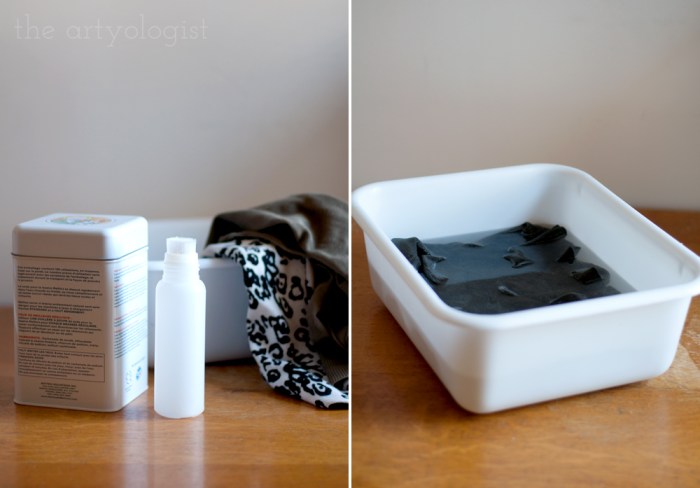
In front, I have a spray bottle of vodka. Despite the fact that my closet is starting to resemble a pantry, it’s not actually for sneaking a drink; it’s for spraying clothes in between washes. Spraying clothes with alcohol is an old theatre trick to keep costumes free of odours in between shows. I use it for delicate and dry clean items or for things that aren’t dirty, but for which I want to extend the time between washes.

wool and fur coats

Now moving down to the rod, on the right I have all of my fancy evening dresses under garment bags in the very back of the closet. Then in front of them I keep my dressy winter coats. I keep these coats in this closet because I like to select them alongside my outfits, whereas I keep my everyday winter coat in the front closet.

hanging scarves and belts

Next I have my scarves, organized in the iconic IKEA Komplement organizer. I didn’t have enough scarves to fill it, so I folded it in half. I don’t love having the scarves in my closet like this, since it makes browsing a bit more difficult, but I don’t have a better place to hang them, so it works for now. In front of the scarf organizer I have a hoop shaped hanger to hold my belts. Again, not the best spot, but it’s what I have for now.
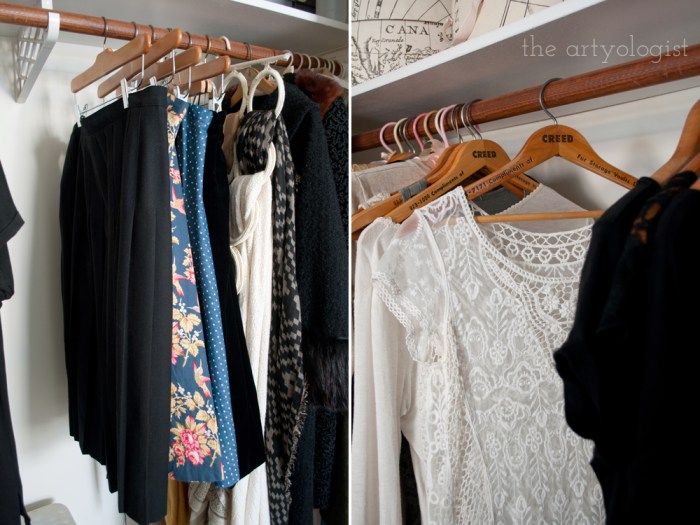
hanging bottoms and tops

After the belts comes bottoms on wooden hangers with clips. I have organized my items by type and each type of garment has a different kind of hanger.

For my tops, I have these vintage wooden hangers I got off of Poshmark. They were originally from a fur storage vault in Toronto. Since I’ve kind of got a capsule wardrobe right now (from getting rid of so many clothes in 2020-2021) I’ve switched from using slim velvet hangers to using these. They definitely take up a lot more horizontal space, and I might not use them forever if I add to my wardrobe in the future, but right now I am quite enjoying seeing these lovely vintage hangers in the morning when I get dressed!

hanging knitwear

After the tops, come the knits. I KNOW you’re not supposed to hang sweaters and knitwear, but I really can’t be bothered to iron or steam creases out every time before wearing them… and so I keep my most commonly worn knits hung up. I use vintage satin padded hangers, which, again, do use a lot of horizontal space, but they are so pretty that it’s worth it! Knits that I don’t wear as often are stored on a shelf, but for these, I’d rather hang them up than be wrinkly.

extra hangers

And at the end of the clothing rod, I keep my extra few hangers from items that are in the laundry.

organized and pretty storage shelves in the closet

Now moving on to the shelves along the left, which hold a lot of my accessories and knitwear. I use the top shelf as a bit of display area; here’s where the aesthetics perhaps take precedence over the economical use of the space.

top display shelf in the closet

I don’t like having all of my jewelry on my dresser, so I store my special occasion pieces here in the closet, and everyday pieces on the dresser. I also like to keep a few hats out on display, so I’ve got one sitting here and one on my dresser. I also put this little miniature tea set here just for fun.

I have a couple purses leaning in the back, but I might replace them in the future with a picture. I have a small print of this piece by Marc Johns, and I’d like to put it in here once it’s framed, even if it’s something that only I will see, because it will bring a smile every time I look at it!

knits and berets on a shelf

The next shelf down also holds knits- the ones I don’t wear as often. I put in this wooden half shelf (which fits perfectly!) so I could double the amount of space and put my berets here too.

row of purses on a shelf

The next two shelves hold my purses and bags. My small vintage clutches and travel shoe bags etc. are stored inside the cream overnight bag and the large wicker bag.

row of purses and luggage on a shelf

And finally, on the floor at the bottom is a basket I use to hold my work clothes… the old ones I wear to refinish furniture or other messy tasks like that, but don’t need access to all the time.

vintage metal laundry hamper

To the right, under the shorter hanging garments, sits my vintage laundry hamper. I will always be indebted to my brother for this hamper, because I found it at the thrift store for $2….and their debit machine wasn’t working. I didn’t have any cash, so he lent me the money (forfeiting whatever he had found) so I could buy it! Since then I have seen people selling these for MUCH more- sometimes for up to $50, so I am so happy that I got it when I did. Oh, and yes, I always carry cash now, just in case!

jewelry oval frame organizer

Now moving out of the closet and to the left, on the wall beside my dresser I have my jewelry frame. I made this probably 14 years ago, and it has proven to be one of my most useful projects. I did a terrible job attaching the fabric with hot glue, but even so, after 14 years it’s still holding up! And it works so well to organize long necklaces, brooches and dangly earrings. I am a person that needs to see what I have or I will forget to wear it, so this works perfectly for me.

drawer full of fur collars

In my dresser I store my “unmentionables”, socks and tights in the top two drawers. And then in the bottom drawer…fur collars! A bit unconventional, but I decided to put them here to keep the dust off them… it works.

rows of shoes on a bookshelf

Lastly, to the right of the closet sits my bookshelf. I use the bottom two shelves to store shoes and boots; I keep my everyday winter boots in the front closet, but all the other shoes stay here. I keep them here so I can match them to my outfits easily, but also to keep them from getting battered in the communal closet! In the basket, are all of my shoe and clothing care items.

So that’s pretty much how I organize my closet! It always varies a bit from season to season, but I think this will be how it stays for a while. This is only my in-season clothing too, by the way. The rest of my summer clothes are stored in two plastic bins under the bed. I don’t like keeping everything in my closet year round because it overwhelms and clutters the space, and I think it is good to give my pieces a rest from hanging if they aren’t being regularly worn.

(Oh and, not pictured, I keep my fabric tote bag and everyday purse hanging on the back of my door, along with my bathrobe and shawl, for easy access.)

How do you set up your closet? Do you like to do a closet organization refresh in the New Year? Do you prefer to put an emphasis on the practicality or the aesthetics when you are organizing?

hat and jewelry box on display

Adding Simple & Subtle Touches of Christmas to Your Decor

a candle and evergreen bouquet on a windowsill with a lace curtain

I just love Christmas decorating! Do you? I change my decorations each year- I can never do exactly the same thing or I get bored with it. This year, while I do have lots of vintage and retro decorations such as glass ball ornaments, mercury glass pieces etc., I didn’t use most of them and instead went for much more laid back, natural and simplified look. In past years I have done a lot more decorating, but this year it just felt right to have a more subtle look for my new space.

If you want to add some festive wintery touches, without going crazy with the faux snow and garlands, here are some ways to incorporate Christmas touches into your space without it looking like Santa’s workshop.

amber bottles of berry branches on top of a shelf with a vintage painting in the background

Faux berry branches look more realistic when you pair them with real branches. You also need very few stems to create an impact. (To see how make a little Christmas tree like this one, see this post here.)

sparkly silver mini wreath on the back of a chair and a candle and bouquet sitting on a windowsill

Sometimes a tiny wreath hanging on the back of a chair, or a vase with evergreens in it is enough to add a festive touch. And of course, candles always add a warm and cozy feeling to any space, at this time of year!

wooden christmas garland

Switch out your summery artwork for wintery artwork. On my dresser mirror, I added a vintage Christmas postcard. (And a little wooden snowflake garland).

I also have two beautiful encaustic pieces by this artist; one is a summery field and blue sky scene, and this one is a beautiful snowy scene. I switch between them, depending on the season.

wintery artwork

Pinecones make great natural seasonal decor. I like to place them around in vignettes. If you have access to pine trees then they are free, and if you don’t feel like storing the pinecones, you can always go and toss them back in the bush after Christmas.

Sometimes you can add a festive touch just by making a few tiny presents to adorn your existing decor; in this case a glass hot air balloon! Or, like with this little cloche, change what you have displayed under the glass.

Also, if you don’t have a tree, you can also hang pretty ornaments in your windows from thread or fishing line, or loop some (unbreakable) ornaments over your doorknobs.

For my mom’s living room mantle, this year we kept it simple with bouquets of evergreen branches and candles of varying heights flanking both sides of the nativity.

nativity scene on a mantle with evergreen bouquets

And, again, pinecones made a great natural garland to ground the candlesticks. I made this one by wiring bunches of pinecones together onto a piece of sisal rope, which we then arranged along the mantle. Lovely golden beeswax tapers finish off the look.

garland of pinecones

Finally, my favourite piece of holiday decor, which is new this year for me, is an advent calendar. I made this one last year out of origami “masu” boxes. (not very well, I might add- I’m definitely not an origami professional. Don’t look too closely, or you’ll see how crooked it is!)

handmade advent calendar

Each box contains a scripture passage and a chocolate to countdown to Christmas; and the best thing about making your own calendar is that you can put better quality chocolates in them, instead of those waxy tasting ones!

How about you? Do you like to change up your decor each year, or stick with a tried and true formula? Do you like to DIY your seasonal decor? 

Christmas Crafting a Little Tree out of Book Pages

diy christmas tree out of book pages on a shelf

December means that it’s time for Christmas crafting as well as decorating! I put up some of my Christmas decor yesterday and today, and I think we might even decorate the tree this weekend.

The majority of my Christmas decorations are ones I’ve found in thrift stores, collected from nature or have made myself- excluding things like faux berry stems. While I love to browse in the boutiques for seasonal decor (I even used to work in a decorating store!) it can get a bit pricey, can’t it? That is why I love to make my own Christmas decor, like this little paper tree. Bottle brush trees have been a huge trend for the past few years, but I’ve never found any that were quite right for my colour scheme. Then, a couple of years ago I saw, in a shop, a tree made out of paper snowflakes and thought, “I bet I could make something like that!” This didn’t turn out quite like the one I saw in the shop, but it was inspired by it, and I do like how I was able to put this together for just a few dollars and a bit of time.

Ps. Yes, I do craft with old books- but I only use previously damaged ones! I have a stack of Reader’s Digest Condensed books that are missing pages or have damaged spines. Though, to be honest, you can find tons of those in thrift shops and I don’t feel bad about repurposing even good copies of them, because they aren’t very valuable on their own. 

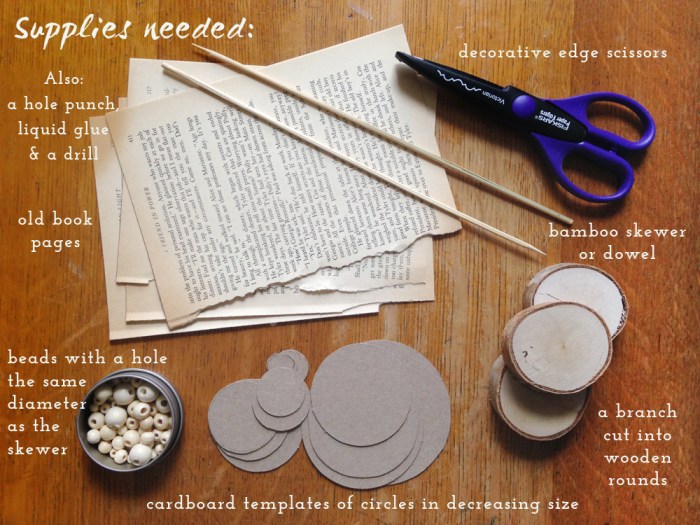
all the supplies needed

For this project you will need:

-old book pages

-wooden dowel or bamboo skewer

-decorative edged scissors. The patterned ones I used were called “Victorian”.

-wooden cookies, or something else to use as a base for the tree

-templates of circles. I traced a bunch of lids, jars etc. onto cardboard.

-wooden beads with a hole the same size as the skewer, to use as spacers

-liquid glue

-a drill if you are using a wooden base

– a hole punch

step one, trace and cut out circles

Step One: Trace your circles onto the pages and cut out with your scalloped scissors. I cut three sheets at a time. You might need more or less circles for different sizes depending on the fullness. I’d start with 4-5 circles of each size.

circles cut and holes punched

Step Two: If you’ve cut your circles from a stack of pages, you might want to trim each piece a bit more so that none of the circles are exactly the same shape. Then punch a hole in the middle of each circle. I used a punch for setting grommets, so I could reach the centre of each piece. If you have a regular hole punch, you could fold the pieces in half to reach the centre.

crumpled pieces ready to go

Step Three: Once all the pieces are punched, it’s time to crumple them! This will give them fullness and dimension.

Step Four: Take your first bead and place it 1.5″ -2″ from the bottom. You might need to glue it in place if the bead isn’t tight enough to not slip out of place.

placing the first pieces on the dowel

Step Five: Now it is time to start stacking the circles on the skewer. Every 4-5 circles or so, place another bead as a spacer, giving room for the pieces to fluff out. The beads will stop the circles from all falling to the bottom, so add them as needed to keep the circles evenly spread out.

stacking circles to make the tree

As you go, you might need to add more circles of some of the sizes so you don’t get empty spots. It’s definitely an art, not a science! As you near the top, you’ll probably need more tiny circles, and you won’t be able to place as many bead spacers since they’ll show too much.

Step Six: Once you finish all the circles, add a final bead and cut the skewer off level with a saw or blade. You could also use a decorative star bead instead of a plain one. I am thinking that I might cover my wooden bead it a bit of glitter, just to give it a bit of sparkle.

adding the base

Step Seven: The final step is adding the base of the tree! I used a birch branch cut into little wooden rounds, drilled a hole for the skewer and then glued it all in place. If you don’t have a branch to cut yourself, I know you can pick these up, pre-cut, at the dollar store.

final tree

Or another idea, that I originally planned to do but couldn’t find the pieces for, is to get a miniature terra cotta pot, paint it white, fill it with clay and then plant the tree into it, covering the clay with fake snow or moss.

After you’ve finished the base, then you’re done- a very quick and easy Christmas craft for a snowy winter afternoon! This tree measures approximately 9″ tall, and I’m thinking it would be cute to make some more of different heights to create a grouping.

Do you enjoy Christmas crafting? Have you ever tried your hand at replicating a piece of decor you’ve seen in a shop? 

finished book page tree

10 Tips for How to Start Writing Letters

a desk with stationery in front of a bouquet of sweet clover and a cup of tea

Letter writing has been around for nearly as long as people have been on this earth. It’s a way to communicate with people if you aren’t able to be there in person and for much of history writing letters has been the only channel of long distance communication. At least until the advent of the telegram, telephone, and internet. As wonderful as those advancements in technology are, though, there’s still something so special about receiving a handwritten note in the mail. I love writing letters, and while I’m not always consistent, I do try to write a few times a year to my friends and family who live far away. I inherited my love of writing letters from my Grandma. She was an excellent letter writer and it was always such a joy to receive one from her in the mailbox! If you aren’t used to writing, here are my tips on how to start writing letters.

a paper pad with a nib pen on top of it and a cup of tea beside it

Of course my first tip is to make yourself a lovely cup of tea (or other beverage) and find a comfortable spot to sit at. Perhaps even light a candle to make the experience more enjoyable. I wouldn’t suggest playing music, though, as I find that I get distracted and start to listen to the music instead of writing! Try to think letter writing as an elegant ritual.

Choose who you will write your letter to and consider your audience. From there, decide if it is to be a formal or casual letter. What you write to your grandmother might not be what you write to a friend. My Grandma often used to leave her writing paper out on the table for a week or more, adding bits and pieces to the letter as she thought of them. They were quite newsy and a joy to read since she’d include tidbits in her letter that you wouldn’t always think to say on a telephone visit. She’d include information about what the weather was like at the time of writing, where she was sitting in the house or about the chickadee she was watching out the window. Details like that really did make reading her letters feel like you were there with her.

If you aren’t used to writing, and don’t quite know where to start, then start slow by sending a greeting card with a heartfelt note written inside. A “thinking of you” card is nice to receive in the mail and it’s not as much pressure to send as a long letter is. Since there are only two pages on the inside of a card, it gives you a boundary to write a quick note without feeling the need to write an entire epistle.

a lovely cup of tea beside a bouquet of clover

Get some good writing paper. It doesn’t have to be stationery, though that is a nice thing to invest in. I often use lined paper that I trimmed out of a journal. It’s a perfect size to fit in an envelope, and the lines help me to stay tidy. Once you’ve gotten the rhythm of writing letters, and perhaps found a pen pal, then getting some dedicated stationery or writing paper is a nice touch. You can find all sorts of beautiful stationery including monogrammed and letterpresses, all the way down to simple plain paper. Keep an eye out for sets of stationery that have matching envelopes in the correct size, so that you don’t have to origami your letter to fit in an envelope for mailing. That being said, I have received letters that were written on construction or copy paper and I never cared, since it was the words on the paper that were of much more importance!

Letter seals or stickers are a fun touch to add to your envelopes- some stationery sets even include matching stickers. Wax seals are another gorgeous touch, that hearken back to the days when security was of utmost importance for top secret correspondence. Another way that letters were kept confidential was through the art of “Letterlocking”. This is a fascinating article from the BBC about how letters in the past used ingenious methods of folding and cutting to ensure that they couldn’t be tampered with. I want to get some heavy writing paper and try out this technique- wouldn’t it be fun to receive a letter like that in the mail?

Another nice touch, is to use a pen that writes really well; I personally prefer liquid ink pens to ballpoint pens. I don’t use a pen with a nib, though I would like to learn how. Right now, I use the Uni-Ball Vision Needle pens in black and I like how they write. I’ve found that when I have a nice smooth pen, my writing is neater. If my pen is scratchy or dry, then my writing gets progressively worse!

writing a letter at a desk with a cup of tea beside the pen and paper

On that note, letter writing is a great way to practice your handwriting. Cursive is another lost art, sadly, and while I don’t have the best handwriting myself, I do like to practice while writing letters. I’ve been trying to slow down when I write, because when I write fast, I might as well write in shorthand considering how illegible it can become!

If you plan to start sending letters often, then buy your stamps in bulk. They aren’t cheaper the more you buy but (at least here in Canada) if you buy a single stamp at the mail counter it is more expensive than buying a pack. Also in Canada, we have “permanent stamps” which means that when the price goes up next time, we can still use the stamps we already own. So buying a roll of stamps might save you money in the future.

Always include a return address, either in the top left hand corner or back of the envelope. Once I mailed a letter but forgot to put on a stamp- oops! At least because I had included a return address, the postal worker just placed it back in my box. Otherwise that letter would have been lost into the abyss! Also, make sure that your letter is clearly and neatly addressed. Some postal services are quite excellent (yay England!) while others can be rather abysmal (looking at you Canada Post).

As for receiving letters in return, if someone does send you a letter back, make sure to answer it in a timely fashion, or you’ll forget what you wanted to say. As I read a letter I’ve received, I find myself thinking of all kinds of things to write back in return but, if I put it off, then I find that I’ve forgotten all of those bits of “news” and have to rack my brain to find something to write down!

Well, those are my tips to start writing letters. Of course, letters can’t replace other forms of communication in our lives, but I think that there is a special art in letter writing, and that it is a lovely way to add a bit of elegance to your everyday life. Oh, and of course I can’t finish off this post without mentioning that if you’re looking for some greeting cards to send, you can check out my shop here or here.

How about you- do you enjoy writing letters? Or do you prefer instant communication instead? If you haven’t in the past, do you think you’ll start writing letters?

writing a letter at a desk with a cup of tea and a bouquet of flowers

Five Garment Care Tips For Your Spring Wardrobe Transition

woman looking into her closet

Now that Spring has officially arrived, it is time for the seasonal wardrobe transition! I always enjoy the changing of the seasons, and all of the things that go along with that… packing away my cold weather garments and then pulling out my warm weather ones always makes for a rather fun afternoon task- it’s kind of like opening presents! Switching your wardrobe around for a new season does take a bit of time, but it is also the perfect opportunity for a bit of garment care and maintenance as well. Here is how I go about switching around my closet, as well as some of the tasks that I like to do each season to keep my clothes and shoes in good condition.

Depending on where you live, transitioning your wardrobe might not be very drastic, and if you don’t live in a climate with four distinct seasons, it might not even be necessary. (Or if you live in the Southern hemisphere, you’ll be pulling out your fall and winter clothes) Here in Alberta we definitely do have four seasons but, while it is now officially spring, we certainly will have some cold days left, so I am not doing a complete wardrobe switch.

There are some etiquette “rules” that I like to follow for my closet, just because they make sense for me and the climate where I live. According to Miss Manners, here are some seasonal wardrobe rules:

Straw should not be worn before Easter nor after Labour Day. 

-Velvet should be worn between October 1 and March 1.

-Furs should not be worn between the months of March to September

-White should not be worn after Labour Day, nor before Memorial Day. (This one is rather archaic, and a better rule to abide by, rather than colour, is judging the weight of the fabric you are wearing. Gauzy white linen is not appropriate for fall and winter, depending on the climate of where you live, of course, but a white wool coat or stockings is a completely different matter!)

clothes laying out ready to be packed away

I moved my strictly winter garments, such as my fur collars, winter coats, berets and lined boots into storage and then rotated my lighter spring and summer items into my closet. While I might not wear some of them right away, because we do still have cool days ahead, I brought them out so I have something to look forward too! I most likely won’t wear my straw hats until Easter, but it’s still nice to take them out and hang them up too. I also don’t have that much space, so I have to trade the items in and out, to fit them all back into my closet. I keep my in-season clothes hanging in my bedroom closet, and put the out-of-season clothes in a suitcase.

I did leave some of the more “seasonally ambiguous” items in my closet, such as my brown Oxford pumps. Rather than moving them out with the winter wear, I decided to keep them in since I might be able to wear them while the days are still cool.

straw hats hanging on a peg rack

Before I put each item into storage, I made sure to look it over and see if it needed any cleaning or other repair. There’s nothing worse than pulling your shoes or clothes out in six months for the next season, and then having to wait to wear it until you can repair it, or even worse than that, it has become irreparably damaged from sitting. So, here are five of my garment care tips to do before packing your winter clothes away for the season.

Doing Laundry

handwashing clothes in a basin

Depending on the soil level, I don’t wash my clothes after every single wear. Some garments can be worn a few times before they need laundering, and if your clothes are delicates then they will actually benefit from less washing. Before you pack the clothes away, though, make sure to clean them so they don’t sit with dirt or odours for months. Dirty clothes in storage can attract moths or other pests, and any light stains on the fabric might set over the months and become a much bigger issue for you later on.

If you have “dry clean” items, you may be able to spot clean them yourself. I don’t like dry cleaning my clothes, because it’s not actually really cleaning and the chemicals are so pollutant and unhealthy. Thus, I prefer to do most of my own washing, though sometimes dry cleaning is a necessary evil. You can often spot clean your wool or hand wash delicate items. If you do decide to wash a woolen item, and it ends up wrinkled or out of shape, you can take it to the dry cleaners for a “press only”. I have done this before with pleated skirts and they come back looking so much better than I could ever get them to look with my iron at home. Once you’ve cleaned your items, make sure they are completely dry before storing. If you are storing your out of season clothes in bins or boxes, you can also add in cedar sachets to keep pests out.

Brushing & Shaving Your Woollens

brushing a wool coat with a lint remover brush

Brushing wool is a new habit for me, and I learned this from the book How to Be a Victorian by Ruth Goodman. She talked about brushing wool clothes rather than washing them in order to clean them, and I had never heard of that! So, I have ordered myself a clothes brush with natural bristles (that is what she recommends in order to not damage the fabric over time) and once it arrives, I plan on brushing all of my winter coats before putting them away.

In the mean time, I will go over my coats with a velvet lint brush, as well as a pill remover/shaver. It’s amazing what a difference a brushing and shaving can do! A clothes brush works so much better than those sticky lint rollers, to take out the dust and dirt that collects. This is a good practice to get into a regular habit of doing, to keep your clothes in good condition, but it is especially important to do before you store your clothes.

Cleaning & Polishing Your Leather Shoes

cleaning your leather shoes

This is such a simple thing to do to keep your leather in good repair, but it’s the one task that I always neglect. I am trying to get better at doing this more frequently, but I always seem to procrastinate and put it off for far longer than I should. (This is probably because shoe polish smells like death…and probably brings you closer to death as well…?) Every time I do get around to polishing my shoes, though, I am amazed at the transformation and vow to do it more often! I haven’t tried any of the more natural leather conditioners yet, but I’ve ordered one to try on my purse. I think it’s a natural wax that doesn’t smell as bad as regular shoe polish, so maybe I’ll use it more often!

shoes ready to be polished

Cleaning and polishing or conditioning your leather is a good thing to do regularly, but is also very important to do before your put your winter shoes away. Salt stains from ice-melt burn leather and if left untreated can ruin a good pair of shoes (I’ve had that happen before!) and other stains will only get worse over time.

First clean your shoes with a leather cleaner and a soft rag. (I clean mine with a suede cleaner solution since that is what I have on hand, and it works well.) Once your shoes are dry, you can polish them with either a cream or wax polish in a matching colour. I’ve heard different cobblers recommend both options, so I’m not sure which is better!

polishing and shining shoes

I’ve also just started using a shoe brush that we got from my Grampa, and I have no idea why I was using just a rag before- the brush gives such a nice polish! I like to finish the shoes off with a little sponge for a nice shine, and then they are done.

polished black high heeled shoes

In the image on the left, the shoe on the left is unpolished, and the shoe on the right shows the difference that polishing makes! The final result is in the photo on the right.

For any shoes that need more serious repairs, you can take them to a cobbler for fixing. I am so hard on my shoes, and have really done a number on some of my favourite pairs (such as ripping the finish off the toe of the aforementioned Oxford heels!) but it’s amazing how cobblers are able to restore them back to – almost- as good as new!

Storing Your Shoes 

shoeboxes with shoes wrapped in tissue paper for storage

Once all of my shoes are polished and clean, I put them into shoe boxes with tissue paper in between to keep them from leaning on each other, and then put them back in my closet. I stack all of my shoeboxes on the top shelf in that inconvenient corner of the closet that you can’t quite reach, since it isn’t useful for storing things you actually need to access on a regular basis!

shoes in fabric shoebags

I don’t have quite enough boxes for all of my boots and shoes, since I only keep the shoeboxes with aesthetics. There were a couple of pairs of boots and shoes that I didn’t have boxes for, so I made some fabric bags to store them in, to keep the dust and dirt off, and they work just as nicely as boxes do.

Using Garment Bags

garment bag over coat hanging on a peg rack

Coats can get so dusty while hanging in the closet over the summer, so I put a garment bag over the top of them- especially after having gone to the trouble to brush them clean! It is important to use cloth garment bags, not the plastic bags that come over dry-cleaning, because plastic can trap in moisture and cause your fabric to get musty. Instead of purchasing garment bags, I made some for myself out of vintage pillowcases. I’ve been using pillowcases as garment bags for a few years now, but had never gotten around to actually sewing them into the proper shape, so I decided it was finally time to do that.

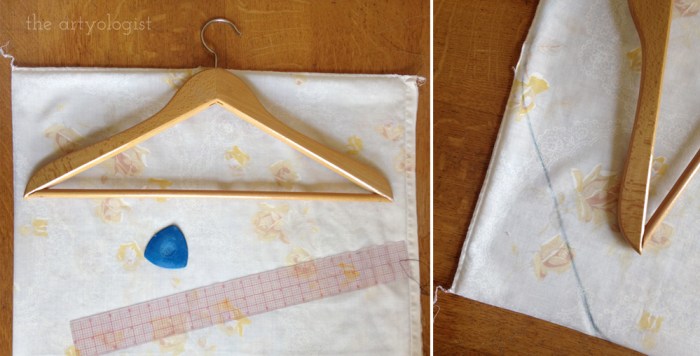
tracing a hanger to make a garment bag

To make your own, all you have to do is take a pillowcase and sew it into the shape you need. Pillowcases are easily found at thrift stores, or maybe you even have a few extra in your linen cupboard (or you can, of course, sew a rectangle of fabric to the width you need). Trace the hanger you will be using onto the wrong side of your pillowcase, and make sure to double check your tracing with a ruler, so you don’t end up with a lopsided angle. Curve the seam where it meets at the sides.

sewing a garment bag out of a pillowcase

Sew along the line, then open a little hole in the seam at the top, for the hanger to go through. I hand stitched the top edge around that hole to keep it from unraveling, and then trimmed off the excess fabric with pinking shears. Flip it inside out and pop it over your coats, and that will keep them nice and clean until next fall!

Once I finished these garment care tasks, my seasonal wardrobe transition was done. Doing these tasks adds some time and is not as much fun, but it is worth it! Keeping your clothes and shoes in good repair will reduce your wardrobe costs over time, since you won’t have to replace your items due to damage. And, not only will it save you money in the long run, but your clothes will look better too; wearing a pair of freshly polished shoes is always going to elevate your outfit!

Do you switch out your wardrobe seasonally? What sorts of garment care or maintenance do you do for your clothes each season?